
Biographical Notes on the Composers (in programme order)
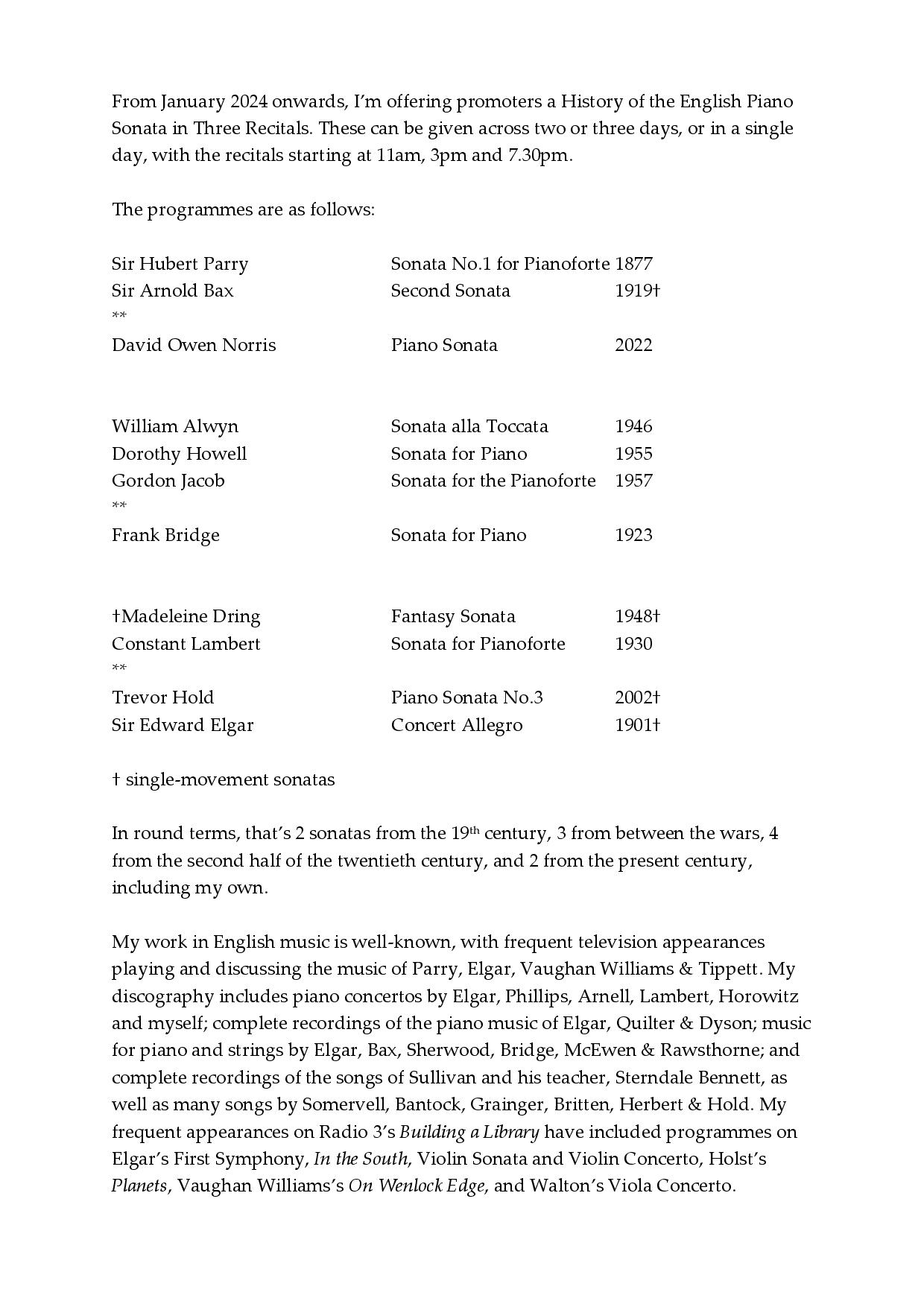
Sir Hubert Parry (1848-1918), director of the RCM, teacher of Vaughan Williams, composer of Jerusalem and I was glad. This delightful early sonata breathes the spirit of Schubert.
Sir Arnold Bax (1883-1953), Master of the King’s Music, both English millionaire and penniless revolutionary Irish poet, composer of Tintagel and of seven symphonies. His dark Second Sonata reflects on the Easter Rising of 1916, in which he lost many Irish friends, and which shatteringly swept away his secret, schizophrenic dual identity. It is curious, to say the least, that one and the same man was banned by the censor during World War One (O’Byrne’s poetry was openly republican) and appointed Master of the King’s Music during World War Two.
David Owen Norris (b.1953) See above.
William Alwyn (1905-1985), composer of 83 film scores and five symphonies. His Sonata alla Toccata is a brilliant treatment of a single cadence, announced at the very beginning, and present in one guise or another throughout the piece.
Gordon Jacob (1895-1984), pupil of Vaughan Williams, influential teacher at the RCM and prolific composer. His sonata develops his teacher’s folksong influences and dark harmonic language.
Frank Bridge (1879-1941), teacher of Benjamin Britten. Like his pupil a convinced pacifist, his Sonata is dedicated to his friend, the composer E.B. Farrar, who was killed in the Great War. It is widely considered his masterpiece.
Madeleine Dring (1923-1977), singer, actress, pupil of Vaughan Williams and Herbert Howells, and composer of the evergreen Five Betjeman Songs. Her ebullient Fantasy-Sonata is somewhat in the mode of Richard Addinsell’s Warsaw Concerto.
Constant Lambert (1905-1951), friend and collaborator of William Walton (he is the dedicatee of Façade), creator of the Sadler’s Wells Ballet Company, who conducted and arranged many works of his teacher, Ralph Vaughan Williams. Composer of Rio Grande, for which, along with his Piano Sonata and Concerto for Piano and Nine Instruments, he coined the term ‘symphonic jazz’.
Trevor Hold (1939-2004), poet, naturalist and composer, many of whose song-cycles are settings of his own words. His Third Sonata (of four) bears an epigraph from Eliot’s Little Gidding: ‘And the end of all our exploring Will be to arrive where we started And know the place for the first time.’
Sir Edward Elgar (1857-1934), a self-taught pianist, played the piano in a way uniquely his own. ‘He has a way of giving the chords some fascinating shades of colour, quite impossible to recapture’, said one friend, and another, ‘he has a beautiful touch, delicate and full of personality.’ He himself said ‘I scramble through things orchestrally in a way that would madden with envy all existing pianists.’